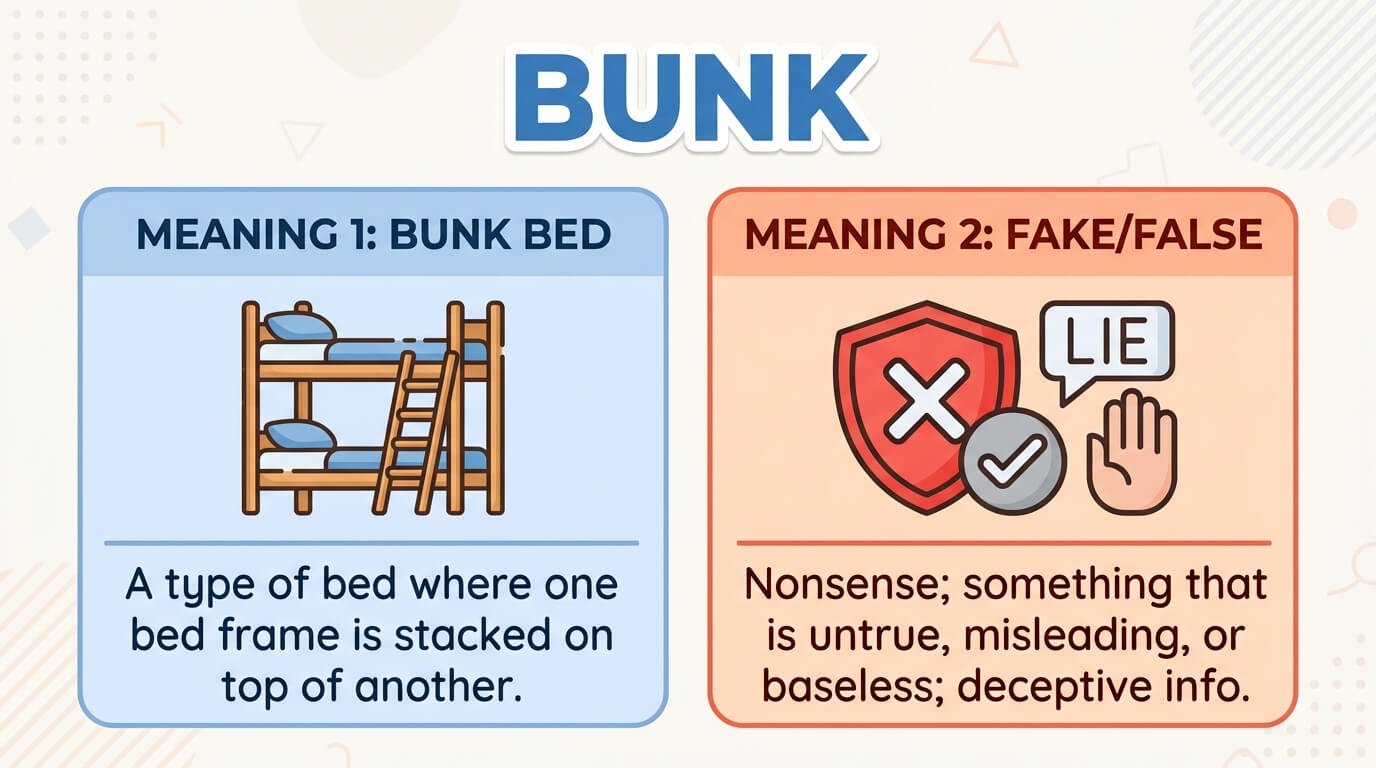
“Bunk” as slang means something fake, false, or worthless like bad information or low quality drugs. It can also mean a bed (bunk bed), or describe leaving suddenly (“doing a bunk”) or skipping school (“bunking off”) in British slang. Context decides which meaning applies.
Key Takeaways
- Core meaning: Fake, false, nonsense, or low quality
- Origin: Traces back to “bunkum,” a 19th century American political term
- Other meanings: A bed (bunk bed), skipping school (British “bunking off”), or fleeing (“doing a bunk”)
- Current usage: Still common in the US for calling something fake or bad; still common in the UK for skipping school
- Tone: Usually negative or dismissive, though “bunk bed” and “bunk up” meanings are neutral
- Popularity: Old slang that has stuck around instead of fading out
People search for “bunk meaning slang” because the word shows up in a lot of different places and doesn’t always mean the same thing.
Someone might hear a friend call a rumor “total bunk.” Someone else might read about a person “doing a bunk” from a hotel bill. A student in the UK might talk about “bunking off” class. And anyone who’s stayed in a hostel or dorm knows a “bunk bed.”
This word has been around for over a hundred years, and it’s still going strong. It shows up in casual conversation, in older slang dictionaries, and even in newer online spaces where people debate what’s real and what’s fake. That mix of old and new is part of why it’s confusing.
This guide breaks down every common meaning of “bunk,” where the word came from, how people use it today, and how to avoid mixing it up with similar sounding slang. By the end, you’ll know exactly what someone means the next time they call something “bunk.”
What Does Bunk Meaning Slang Mean?
“Bunk” mainly means something fake, false, or not worth taking seriously. If someone says a story is “bunk,” they mean it’s nonsense or made up.
The word can also describe a physical bed, especially a stacked one like in a dorm room or ship’s cabin.
In British English, “bunk” shows up in phrasing about skipping school or running off without paying. These meanings don’t overlap much, so the sentence around the word usually makes the meaning obvious.
For example, “That rumor is bunk” is clearly about something being false, while “I sleep on the top bunk” is clearly about furniture.
Quick Meaning Box
| Meaning | Simple Explanation |
| Fake or false | Something untrue, made up, or not credible |
| Low quality (drugs) | Weak, fake, or cut drugs that don’t work as expected |
| A bed | Short for “bunk bed,” a stacked sleeping frame |
| To bunk (UK) | To skip school or work without permission |
| To do a bunk (UK) | To leave suddenly, often to avoid paying or facing something |
Pronunciation
“Bunk” is pronounced just like it looks: buhngk (rhymes with “monk” or “trunk”). One syllable, no tricky sounds.
Where Does Bunk Meaning Slang Come From?

The slang sense of “bunk” (fake or nonsense) most likely comes from “bunkum,” a much older American word. The exact origin of the shortened slang form “bunk” is unclear, but it’s widely accepted as a clipped version of “bunkum.”
“Bunkum” itself has a documented backstory. It’s tied to Buncombe County, North Carolina, from a story about an early 1800s congressman who kept giving a long,
pointless speech simply to have something “for Buncombe” meaning for his constituents back home, regardless of if it made sense on the House floor. Over time, “bunkum” came to mean empty, meaningless talk, and it eventually got shortened to “bunk” in everyday speech.
The bed related meaning of “bunk” comes from a completely different, older root tied to wooden sleeping berths on ships.
The British meanings around skipping school or fleeing developed separately as informal British English slang, and the exact timeline for those uses is harder to pin down.
History of the Term
“Bunkum” was already used in American political speech before the shorter “bunk” caught on. Over the 1900s, “bunk” became the more common everyday version, especially for calling out nonsense in regular conversation, not just politics.
The bed related “bunk” has stayed steady in meaning for a long time, mostly used for stacked beds in ships, army barracks, camps, and dorms.
The British sense of “bunking off” school and “doing a bunk” grew as separate informal expressions in the UK. These aren’t tied to the same political origin as “bunkum” they’re generally treated as their own branch of British slang.
More recently, “bunk” picked up a specific use in conversations about drugs, where it describes something fake, weak, or not what it was supposed to be. This use didn’t need to reinvent the word; it simply applied the “fake” meaning to a new context.
How People Use It Today

“Bunk” still gets used online and in texting, mostly to dismiss something as fake or not credible. On X and Reddit, people call bad information, scams, or exaggerated claims “bunk” in comment sections and replies.
In gaming and Discord chats, players sometimes call weak items, unfair matchmaking, or shady deals “bunk.” The word isn’t a trending meme term it’s more of a reliable, low key slang word that keeps getting reused because it’s short and to the point.
Bunk Meaning Slang Urban Dictionary Definition
Urban Dictionary entries for “bunk” mostly agree with the standard slang meaning: fake, bad, or worthless. Many entries also point specifically to bad quality drugs as a common context.
Because Urban Dictionary is crowdsourced, definitions vary in wording and quality, but the overall theme stays consistent across entries: something described as “bunk” is being called out as fake or disappointing.
Bunk Meaning Slang Drug
In drug slang, “bunk” describes drugs that are fake, weak, or cut with other substances so they don’t work the way they’re supposed to. Calling a product “bunk” is a warning that it’s not the real thing or not worth the money.
This use fits the general “fake” meaning of the word it’s just applied specifically to substances instead of stories or claims.
Bunk Meaning Slang California
“Bunk” isn’t a California only term, but it does show up often in West Coast slang conversations, partly because of its ties to drug related slang and casual conversation in that region.
There’s no solid evidence that the word originated in California specifically; it’s a nationwide slang term that gets heavy use in some regional slang lists.
Top Bunk Slang Meaning
“Top bunk” simply refers to the upper bed in a stacked bunk bed setup, common in dorms, army barracks, ships, and kids’ bedrooms. There’s no hidden slang meaning here it’s a literal, straightforward term describing which bed someone sleeps in.
Bunk Up Meaning Slang
“Bunk up” usually means to share a sleeping space or team up with someone temporarily, like sharing a room or a bed with a friend during a trip.
It can also loosely mean joining forces with someone for a short task. This phrase carries a neutral, practical tone rather than a negative one.
Bunkers Meaning Slang
“Bunkers” as slang can describe someone acting stubborn, closed off, or overly defensive, similar to “hunkering down” in an argument or refusing to budge.
It’s a less common slang use compared to the standard meaning of “bunker” as a shelter, so context matters a lot here.
Bunky Meaning Slang
“Bunky” is an informal, friendly nickname for a roommate or someone who shares a bunk or living space, similar to calling someone “roomie.” It has a warm, casual tone and isn’t meant as an insult.
Bunking Meaning Slang
“Bunking” usually refers to sharing sleeping space with someone, as in “we’re bunking together this weekend.
” In British slang, “bunking” (often “bunking off”) means skipping school or work without permission. Both uses are common, so the surrounding sentence tells you which one is meant.
Bunko Meaning Slang
“Bunko” (sometimes spelled “bunco”) refers to a con game or a trick meant to deceive someone, often tied to old school scams and swindles.
It’s also the name of a simple dice game played at social gatherings, which is unrelated to the scam meaning. These are two separate uses that just happen to share a spelling.
Bunker Down Meaning Slang
“Bunker down” means to settle in and stay put, usually to ride out a difficult situation, bad if, or a busy stretch of work. It’s often used the same way as “hunker down,” describing someone who’s staying focused and sheltered rather than moving around.
Examples in Everyday Conversation
- “Don’t believe that email, it’s total bunk.”
- “I heard that story is bunk nobody actually said that.”
- “This mattress is garbage, I’ve had better on a bunk bed.”
- “He tried to bunk off practice again today.”
- “The whole excuse sounded like bunk to me.”
- “She did a bunk before the bill even came.”
- “That review is bunk, the product barely works.”
- “We’re bunking together at the hostel this weekend.”
- “That last batch was bunk, don’t buy from him again.”
- “Stop spreading bunk, check your facts first.”
Text Message Examples
- “lol that rumor is so bunk”
- “guy sold me bunk, never again”
- “top bunk or bottom bunk tonight?”
- “she totally bunked off today lol”
- “that article is bunk don’t share it”
- “we’re bunking up at my cousin’s place”
- “he did a bunk before splitting the bill 💀”
- “that whole story sounds bunk ngl”
- “bunker down, storm’s coming”
- “that trick was pure bunko”
Social Media Caption Examples
- TikTok: “POV: the ‘miracle’ hack is 100% bunk”
- X: “That headline is bunk, read the actual report.”
- Threads: “Bunking with my best friend for the reunion 🙌”
- Facebook: “Kids fighting over the top bunk again lol”
- Instagram: “Some reviews online are just bunk, trust your gut”
- TikTok: “Bunker down mode: activated ❄️”
- X: “That excuse was bunk and everyone knew it”
- Threads: “First night bunking together at camp!”
- Facebook: “Beware of bunk products from that seller, learned the hard way”
Is Bunk Meaning Slang Positive or Negative?
The main slang meaning of “bunk” (fake or worthless) is negative. It’s used to dismiss, criticize, or call out something as untrustworthy. It can come across as blunt or rude if aimed directly at a person’s words or claims, so tone matters.
The bed related and “bunking together” meanings are neutral or even friendly, since they’re just describing sleeping arrangements.
Misunderstandings usually happen when someone hears “bunk” and assumes the negative meaning by default, even when the speaker meant the bed or roommate sense.
Who Uses This Slang?
Adults and older speakers commonly use “bunk” to call out fake claims, scams, or nonsense. Teens and younger users may use it less often for the “fake” meaning but still recognize “bunk bed” and “bunking” without any confusion.
Gamers sometimes borrow the “fake or low quality” meaning to describe bad in game items or unfair situations. In the UK specifically, students and younger speakers commonly use “bunking off” for skipping school, a phrase less common in American English.
Similar Slang Words
| Slang | Meaning |
| Bogus | Fake or not genuine |
| Sus | Suspicious or untrustworthy |
| Cap | A lie or exaggeration |
| Fugazi | Fake or counterfeit |
| Shady | Untrustworthy or questionable |
Opposite Words
- Legit real, genuine, trustworthy
- Solid dependable and good quality
- Facts true, accurate information
- Verified confirmed as real or accurate
Common Mistakes
People sometimes confuse “bunk” with “bunker,” assuming they always mean the same thing, but “bunker” more often refers to a shelter or golf hazard rather than something fake. Others misspell it as “bunck” or “bunc,” which aren’t standard spellings.
Another common mix up is assuming “bunk” always relates to drugs, when in most everyday conversations it’s just describing something false or low quality in general.
When NOT to Use Bunk Meaning Slang
Avoid using “bunk” in professional emails, school assignments, resumes, or formal writing. Calling a coworker’s report “bunk” in a meeting can come across as unprofessional or disrespectful, even if that’s not the intent.
In formal settings, safer alternatives include “inaccurate,” “unverified,” or “not credible,” which say the same thing without sounding slangy or dismissive.
Fun Facts
- “Bunk” is widely believed to come from “bunkum,” a much older American English word.
- “Bunkum” is tied to a real U.S. county name: Buncombe County, North Carolina.
- The bed related meaning of “bunk” comes from a separate word history than the “fake” meaning.
- “Bunking off” for skipping school is much more common in British English than American English.
- “Bunko” and “bunk” share a similar sound but developed as distinct slang terms.
- The word has stayed in steady use for well over a century without fading out.
Frequently Asked Questions
1:What does bunk up mean in slang?
“Bunk up” means to share a sleeping space or team up with someone for a short period, like splitting a room during a trip or camping out together.
It’s a casual, practical phrase and doesn’t carry a negative meaning. You’ll hear it used between friends, coworkers on a work trip, or family members sharing space during a visit.
It’s different from the “fake” meaning of bunk, since “bunk up” is always about sharing space or effort, not honesty or quality.
2:What is a synonym for the word bunk?
Common synonyms for “bunk” (meaning fake or nonsense) include “bogus,” “baloney,” “nonsense,” and “hogwash.” These words all describe something untrue or not worth taking seriously.
If someone wants a slightly more modern sounding synonym, “cap” works well in casual conversation. For the bed related meaning, a fitting synonym is simply “berth” or “cot,” though “bunk” is far more commonly used than either of those alternatives in everyday speech.
3:What does “she’s done a bunk” mean?
“She’s done a bunk” is a British expression meaning she left suddenly, often to avoid a bill, a responsibility, or an uncomfortable situation.
It’s commonly used when someone skips out on paying rent, a restaurant tab, or a debt without warning. This phrase is distinct from the “fake” meaning of bunk it’s specifically about the act of fleeing or disappearing, not about honesty or quality of something.
4:What is the meaning of bunk?
At its core, “bunk” most often means something fake, false, or not worth believing. It can also refer to a bed, especially a stacked bunk bed, or appear in British phrases about skipping school (“bunking off”) or leaving suddenly (“doing a bunk”).
The correct meaning always depends on the sentence around it, since these uses don’t overlap much in everyday conversation.
Final Thoughts
“Bunk” is one of those slang words that’s stuck around because it’s short, clear, and useful in a lot of situations.
If someone’s calling out a fake story, talking about a stacked bed, or describing skipping school across the pond, the word adapts easily to context.
Knowing all its meanings and which one fits a given sentence makes it easier to understand casual conversations, older slang references, and British English phrasing without getting tripped up. Next time someone calls something “bunk,” you’ll know exactly what they mean.

Ethan Brooks writes clear and engaging content about language, slang, and modern communication. He helps readers understand everyday expressions through expert articles on slangwordz.com.