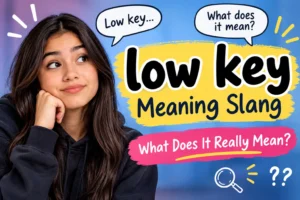
In slang, “low key” means somewhat, secretly, quietly, or not openly expressing something. People use it to share a feeling, opinion, or desire in a casual, understated way. For example, “I’m low-key excited” means you’re excited but aren’t showing it strongly. It can also mean keeping something private or avoiding attention.
Key Takeaways
- Low key means slightly, secretly, quietly, or without drawing attention.
- People often use it to express feelings they do not want to emphasize.
- It is common in casual conversations, texts, memes, and social media.
- Gen Z uses it naturally, but the expression is not limited to younger people.
- Its opposite in modern slang is often high-key, meaning openly or strongly.
- The expression can communicate excitement, attraction, embarrassment, annoyance, or a private opinion.
Have you ever seen someone write, “I’m low-key obsessed with this song” or “I low-key want to leave”? You might wonder why they use those two words instead of simply saying what they feel.
This expression is popular because it makes a statement sound casual and less intense. Someone can share a strong feeling without making it seem like a big announcement. It can also suggest that a person wants to keep something quiet or does not want everyone to know.
You may encounter it in Instagram captions, TikTok comments, Snapchat messages, online conversations, and everyday speech. Friends also use it when talking about relationships, food, music, school, work, and personal opinions.
The expression has been around longer than many people realize. It did not begin with Gen Z or social media. However, online communication helped make its informal meaning familiar to a wider audience.
Understanding the low key meaning slang helps you recognize the speaker’s tone. Depending on the sentence, it can mean a little, secretly, honestly, or without attracting attention.
The important thing is context. Sometimes the speaker is describing a quiet action. Other times, they are softening an emotion or admitting something they might not say directly.
This guide explains its meanings, history, modern uses, and differences from similar expressions. You will also find realistic conversation examples to help you use it naturally.
What Does Low Key Meaning Slang Mean?
In informal English, low-key usually means somewhat, secretly, quietly, or without making something obvious. It can soften a statement or suggest that someone wants to avoid attention.
The expression has several related uses.
1. Somewhat or a little
This meaning makes a feeling or opinion sound less intense.
Example: “I’m low-key tired.”
Meaning: I’m a little tired, or I’m more tired than I want to admit.
2. Secretly or privately
It can describe a feeling or desire that someone does not openly share.
Example: “I low-key like him.”
Meaning: I like him, but I may not want everyone to know.
3. Without attracting attention
It can describe an action or event that happens quietly.
Example: “Let’s have a low-key birthday party.”
Meaning: Let’s celebrate without a large crowd or an extravagant event.
4. Honestly or actually
In some conversations, it introduces a genuine opinion that the speaker is expressing casually.
Example: “That movie was low-key amazing.”
Meaning: I genuinely thought that movie was amazing.
These meanings are connected, but they are not always interchangeable. The surrounding sentence tells you which meaning fits best.
Quick Meaning Box
| Meaning | Simple Explanation |
| Somewhat | A little or slightly |
| Secretly | Without openly admitting something |
| Quietly | Without attracting attention |
| Understated | Not overly dramatic or obvious |
| Casually | Expressing an honest thought without making a big deal |
Pronunciation
The expression is pronounced:
LOW-kee
- Low rhymes with “show.”
- Key rhymes with “see.”
It has two syllables and is easy to say in everyday conversation.
In informal writing, you may see several spellings:
- Low-key
- Low key
- Lowkey
All three can communicate the same expression. The hyphenated form is common in standard writing, while “lowkey” is especially familiar in casual online messages.
Where Does Low Key Come From?
The expression comes from the older English phrase “low-key,” which describes something understated, restrained, or not intense.
The word “key” has a history in descriptions of musical pitch, tone, and artistic style. Over time, “low-key” also became established as a way to describe something subtle or restrained.
The exact origin of the modern slang use is unclear. It would be inaccurate to claim that one social media platform, generation, or individual invented it.
The expression existed before modern social media. Its informal use developed from the broader idea of keeping something quiet, subtle, or less noticeable.
In contemporary conversations, people extended this meaning to emotions and opinions. Instead of describing only a quiet event, they began using it to communicate understated feelings.
For example, “I’m low-key nervous” does not necessarily mean someone is hiding a secret. It can simply mean they feel nervous but do not want to make the emotion sound overwhelming.
This change helped make the phrase useful in everyday conversation.
History of the Term
The expression developed from a description of quietness into a flexible way to express personal feelings.
Here is a simple timeline of its development:
1800s: Describing a quiet tone
The phrase appeared in English writing to describe a low-pitched voice or restrained tone. Charles Dickens used the expression in Martin Chuzzlewit (1844) when describing speech delivered in a low key.
Late 1800s: A broader meaning
The phrase began describing things that were modest, subdued, or not especially noticeable. It could refer to an event, personality, or general style.
Late 2000s: Informal online use
The adverbial form became visible in online conversations. People started using it before verbs and opinions to suggest a private or moderate feeling.
2010s: Wider popularity
Hip-hop and internet culture helped spread the informal expression. It became familiar in social media posts, music discussions, and everyday conversations.
2020s: Everyday digital language
The expression became familiar across different age groups. People use it in captions, comments, text messages, and spoken conversations.
Its meaning has remained fairly stable, even as new situations and humorous uses have appeared.
How People Use It Today
People use the expression to make statements sound less intense, share private feelings, or describe something relaxed. Its meaning depends on the words around it.
Here are some common settings:
Text messages: Friends use it to admit feelings without sounding too serious.
Example: “I low-key miss our old school.”
TikTok: Users include it in comments and captions to express reactions, opinions, and unexpected interests.
Example: “Low-key the best outfit I’ve seen today.”
Instagram: It appears in captions about relationships, travel, food, fashion, and personal experiences.
Example: “Low-key wishing I was back at the beach.”
Snapchat: It can make a confession sound playful or less direct.
Example: “I low-key wanted you to text first.”
Discord and gaming: Players may use it to describe a quiet preference, an unexpected opinion, or a game they secretly enjoy.
Example: “I low-key prefer the older version.”
X and Threads: People use it to make short opinions sound casual or humorous.
Example: “Low-key need a vacation already.”
The expression works best in informal settings. It does not require a particular platform or age group.
Lowkey Meaning Slang
This search phrase refers to the informal use of low-key as a way to express something secretly, slightly, or without much emphasis.
For example:
“I’m lowkey hungry.”
This means the speaker is somewhat hungry.
“I lowkey want to buy those shoes.”
This suggests that the speaker wants the shoes but is expressing the desire casually.
The expression can also soften criticism.
“That restaurant was low-key disappointing.”
The speaker is expressing dissatisfaction without making the statement sound overly dramatic.
The spelling “lowkey” is common in informal digital writing. The standard hyphenated form, “low-key,” is also widely accepted.
Lowkey Meaning Slang Gen Z
Gen Z commonly uses this expression to describe feelings, preferences, and opinions without making them sound too serious.
It can communicate a small confession or an understated reaction.
For example:
- “I’m lowkey obsessed with this playlist.”
- “I lowkey want to go home.”
- “That was lowkey embarrassing.”
- “She’s lowkey really funny.”
In these sentences, the expression makes the statement feel relaxed and conversational.
Although it is associated with Gen Z internet language, it is not exclusive to that generation. Adults and older speakers also use it.
Gen Z did not invent the phrase. Younger internet users helped make its informal adverbial use more visible in everyday digital communication.
Low Key Meaning Slang Gen Alpha
Gen Alpha may use the expression in a similar way to Gen Z. It can mean somewhat, secretly, or without openly showing a feeling.
For example:
“That game is lowkey fun.”
This means the speaker finds the game more enjoyable than expected.
“Lowkey, I don’t want to go.”
This communicates a preference without making a dramatic announcement.
However, not every young person uses the same slang. Age groups also share expressions through siblings, friends, music, videos, and online communities.
It is better to understand the sentence than assume a particular meaning based only on someone’s age.
Low Key Meaning Slang Examples
Here are some simple examples showing how the expression changes according to context.
| Sentence | Meaning |
| I’m low-key excited. | I’m somewhat excited. |
| I low-key miss you. | I secretly or quietly miss you. |
| That song is low-key amazing. | That song is surprisingly good. |
| She’s low-key funny. | She’s actually quite funny. |
| I’m low-key jealous. | I feel a little jealous. |
| Let’s keep it low-key. | Let’s avoid making a big deal. |
| He is a low-key person. | He avoids attention. |
| We had a low-key dinner. | We had a simple, relaxed dinner. |
Notice that the expression does not always mean the same thing.
Sometimes it describes a person’s personality. In other cases, it changes the intensity of an emotion or opinion.
Lowkey Meaning Slang Urban Dictionary
Urban Dictionary contains user-submitted slang definitions, so its entries may include different interpretations and informal examples.
In general, its explanations of “lowkey” reflect two familiar ideas: feeling something privately and experiencing something to a moderate degree.
For example:
“I lowkey want that new phone.”
This means the person wants the phone but is not making a big announcement about it.
User-submitted definitions can help explain how people use slang online. However, they should not be treated as proof of a word’s original history or official meaning.
For a more reliable general definition, Dictionary.com describes the expression as restrained, discreet, or limited in intensity.
Lowkey Meaning Slang in Hindi
In Hindi, the expression can have different translations depending on the situation.
Common equivalents include:
- थोड़ा सा (Thoda sa): A little or somewhat.
- चुपके से (Chupke se): Secretly or quietly.
- मन ही मन (Man hi man): Privately or in one’s thoughts.
- बिना दिखाए (Bina dikhaye): Without showing it openly.
Examples:
“I’m lowkey happy.”
Hindi: “मैं थोड़ा खुश हूँ।”
Meaning: I’m somewhat happy.
“I lowkey like her.”
Hindi: “मुझे मन ही मन वह पसंद है।”
Meaning: I like her, but I may not openly admit it.
“Let’s keep it low-key.”
Hindi: “इसे सादगी से रखते हैं।”
Meaning: Let’s keep things simple and avoid unnecessary attention.
There is no single Hindi word that works in every situation. Choose the translation according to the sentence.
Lowkey Meaning Slang in Arabic
Arabic translations also depend on context and the speaker’s intended meaning.
Some useful equivalents include:
- قليلاً (Qalīlan): A little or slightly.
- سراً (Sirrā): Secretly.
- بهدوء (Bi-hudū’): Quietly or calmly.
- بشكل غير ملفت (Bi-shakl ghayr mulfit): In an inconspicuous way.
Examples:
“I’m lowkey tired.”
Arabic: أنا متعب قليلاً.
Meaning: I’m a little tired.
“I lowkey like this song.”
Arabic: أنا أحب هذه الأغنية سراً.
Meaning: I secretly like this song.
“Let’s keep it low-key.”
Arabic: لنبقِ الأمر بسيطاً وهادئاً.
Meaning: Let’s keep things simple and quiet.
These are contextual translations rather than exact slang equivalents. The best choice depends on the dialect and situation.
Lowkey Meaning Slang TikTok
On TikTok, people commonly use the expression in captions, comments, and video text to share casual reactions.
It can make an opinion sound funny, honest, or slightly unexpected.
Examples include:
- “Lowkey need this outfit.”
- “This recipe is lowkey incredible.”
- “Lowkey didn’t expect that ending.”
- “I’m lowkey obsessed with this trend.”
It also appears in humorous videos where someone admits a feeling that they might usually keep private.
For example, a creator might post a video about enjoying a song they previously said they disliked, with the caption “I lowkey love this song.”
The phrase is not exclusive to TikTok. It has a much longer history, and the platform is one of several places where people use it.
Lowkey Meaning Slang in Spanish
Spanish has several expressions that can communicate the same idea.
Useful translations include:
- Un poco: A little or somewhat.
- En secreto: Secretly.
- Discretamente: Discreetly.
- La verdad: Honestly or actually, depending on context.
- Sin llamar la atención: Without attracting attention.
Examples:
“I’m lowkey excited.”
Spanish: Estoy un poco emocionado.
“I lowkey like him.”
Spanish: En secreto, me gusta.
“Let’s keep it low-key.”
Spanish: Mantengámoslo discreto.
These translations are not exact replacements in every situation. Spanish speakers may choose different expressions depending on their country and conversational style.
High Key vs Low Key Meaning Slang
High-key and low-key are often used as opposites in casual conversations.
Low-key suggests something is understated, private, or moderate. High-key suggests something is obvious, strong, or openly expressed.
| Term | Meaning | Key Difference |
| Low-key | Somewhat, secretly, or quietly | Softens or hides the intensity |
| High-key | Definitely, openly, or strongly | Emphasizes the feeling |
| Secretly | Without others knowing | Focuses on privacy |
| Kinda | To some extent | Focuses on degree |
| Very | To a high degree | Expresses stronger intensity |
Examples:
- Low-key: “I’m low-key excited about the trip.”
- High-key: “I’m high-key excited about the trip.”
The first sentence sounds more understated. The second makes the excitement obvious.
Another example:
- Low-key: “I low-key want pizza.”
- High-key: “I high-key want pizza.”
Both express a desire, but the second sounds much stronger.
These expressions are informal. They are not exact opposites in every sentence, but they often work as a contrast.
Examples in Everyday Conversation
Here are 10 natural conversations showing how people use the expression.
1. Talking about food
Alex: Do you like that new pizza place?
Sam: Yeah, it’s low-key amazing.
2. Talking about a crush
Mia: Do you like Jordan?
Ella: I low-key do, but don’t tell anyone.
3. Making weekend plans
Chris: Want to go to a big party?
Jake: Not really. I want something low-key.
4. Talking about school
Nina: How was your exam?
Lily: It was low-key difficult.
5. Discussing music
Ben: Have you heard the new album?
Ryan: Yes! I’m low-key obsessed with it.
6. Talking about work
Ava: Are you tired today?
Emma: Low-key exhausted, actually.
7. Sharing an opinion
Noah: Did you enjoy the movie?
Ethan: I low-key thought it was better than the first one.
8. Talking about shopping
Olivia: Are you buying those sneakers?
Sophia: I low-key want them, but they’re expensive.
9. Discussing a surprise
Daniel: Did you know about the party?
Michael: Yeah, I low-key suspected something.
10. Talking about travel
Grace: Do you want a busy vacation?
Chloe: No, I want a low-key weekend by the beach.
Text Message Examples
These examples show how friends might use the expression in everyday texting.
- “I’m lowkey bored rn.”
- “Lowkey wish you were here.”
- “I lowkey forgot about our plans.”
- “That restaurant looks lowkey expensive.”
- “I’m lowkey nervous about tomorrow.”
- “Lowkey want to watch another episode.”
- “You were lowkey right about that.”
- “I lowkey need a break from everything.”
- “That picture is lowkey cute.”
- “I’m lowkey proud of myself today.”
The word makes each message feel casual and natural. It can also soften a statement that might otherwise sound too direct.
Social Media Caption Examples
Here are 10 original caption ideas suitable for different social platforms.
| Platform | Caption |
| Lowkey living my best life. | |
| Lowkey missing summer already. | |
| TikTok | Lowkey didn’t see that coming. |
| TikTok | This trend is lowkey addictive. |
| X | Lowkey tired of Monday mornings. |
| X | That was lowkey the best decision. |
| Threads | Lowkey enjoying my quiet era. |
| Threads | I lowkey needed this reminder. |
| Lowkey grateful for the little things. | |
| Keeping this weekend low-key and peaceful. |
These captions work because they communicate a feeling without making it sound overly serious.
Is It Positive or Negative?
The expression is neither positive nor negative by itself. Its emotional meaning depends on the words and situation.
Positive uses
People use it to express happiness, attraction, excitement, or appreciation.
Examples:
- “I’m lowkey proud of you.”
- “That dress is lowkey beautiful.”
- “I lowkey love this song.”
Negative uses
It can also introduce frustration, disappointment, jealousy, or criticism.
Examples:
- “I’m lowkey annoyed.”
- “That comment was lowkey rude.”
- “I lowkey regret buying it.”
Friendly or playful uses
Friends often use it to make honest opinions sound less serious.
Example: “You’re lowkey funny.”
When can it sound rude?
It may sound rude when someone uses it to hide an insult or make a negative comment seem harmless.
For example, “You’re lowkey annoying” is still criticism, even though the speaker softens it with slang.
It can also cause confusion in serious conversations. Someone might interpret a quiet confession as a joke when the speaker genuinely means it.
Who Uses This Slang?
The expression is used by people across different age groups, especially in informal conversations and online communication.
Teenagers: Young people may use it when discussing friendships, school, relationships, entertainment, and personal interests.
Gen Z: The expression is familiar in Gen Z slang and everyday internet conversations.
Gen Alpha: Younger internet users may encounter and use it through videos, gaming, and conversations with older siblings or friends.
Adults: Adults also use it when talking casually with friends, family, and coworkers.
Gamers: Players may use it to express unexpected preferences or opinions about a game.
Social media users: Instagram, TikTok, Snapchat, X, and Threads users may include it in captions, comments, and messages.
The expression is not limited to one location or community. Its use can vary according to personal preference and social setting.
Similar Slang Words
Several informal expressions communicate ideas similar to this one.
| Slang | Meaning |
| High-key | Openly or strongly |
| Kinda | Somewhat or a little |
| Sorta | To some extent |
| Low-profile | Avoiding attention |
| On the down low | Kept private or secret |
| Secretly | Without others knowing |
| Fr | For real; genuinely |
| Ngl | Not gonna lie |
| Tbh | To be honest |
| Chill | Relaxed or easygoing |
| Subtle | Not obvious or noticeable |
These expressions are not perfect replacements. For example, “NGL” introduces honesty, while “low-key” often softens the intensity of a feeling.
Opposite Words
The best opposite depends on which meaning is intended.
- High-key: Openly or strongly expressing something.
- Obvious: Easy to notice or recognize.
- Loud: Expressive, attention-grabbing, or noisy.
- Outspoken: Willing to express opinions openly.
- Over-the-top: Excessive or unnecessarily dramatic.
- Publicly: In front of other people rather than privately.
- Intense: Strong in feeling or degree.
For example, a low-key celebration is simple and relaxed. An over-the-top celebration is large, elaborate, and attention-grabbing.
Common Mistakes
People sometimes misunderstand the expression because it can have several related meanings.
Here are some common mistakes to avoid.
1. Thinking it always means secretly
It can mean secretly, but it can also mean somewhat or moderately.
“I’m low-key hungry” usually means somewhat hungry, not necessarily that someone is hiding their hunger.
2. Confusing it with high-key
The expressions often contrast with each other.
Low-key suggests a restrained feeling, while high-key emphasizes something openly or strongly.
3. Assuming it always describes a person
It can describe feelings, activities, events, opinions, and personalities.
For example, a low-key wedding is a relaxed celebration, not necessarily a quiet person.
4. Thinking it is only for teenagers
People of different ages use the expression. It is informal, but not limited to one generation.
5. Using it in every sentence
Repeating it too often can make your writing sound unnatural. Use it when it adds meaning.
6. Assuming every use involves a secret
Sometimes the speaker simply wants to make a statement sound less intense.
When NOT to Use It
Although the expression is common in casual English, it is not suitable for every situation.
Professional emails
Avoid writing “I’m low-key worried about the project” in a formal business email.
A clearer alternative is: “I have some concerns about the project.”
Academic assignments
Formal essays should use precise vocabulary instead of casual internet slang.
Instead of “The results are low-key surprising,” write “The results are somewhat surprising.”
Job interviews
Using too much slang can make your answers sound less professional.
Instead of “I’m low-key excited about this position,” say “I’m genuinely excited about this opportunity.”
Business presentations
Use clear language that every audience member can understand.
Instead of “This strategy is low-key risky,” say “This strategy involves some risk.”
Formal documents
Contracts, reports, research papers, and official notices require precise wording.
The main reason to avoid the expression in these settings is clarity and tone. It is not incorrect English, but it may sound too casual for the audience.
Fun Facts
Here are seven interesting facts about the expression:
1. It existed before social media. The phrase appeared in English writing long before TikTok, Instagram, and other modern platforms.
2. It has musical connections. Older uses of “low key” referred to a low-pitched or subdued tone.
3. It can work as an adjective. A low-key event is simple, relaxed, and not designed to attract much attention.
4. It can also work as an adverb. In “I low-key love this,” it modifies the feeling or statement.
5. It has multiple spellings. Low-key, low key, and lowkey are all recognizable forms.
6. High-key is its common slang counterpart. People use it to emphasize something rather than soften it.
7. It can express mixed feelings. Someone might say they are low-key nervous and excited at the same time.
Frequently Asked Questions
1. What does “lowkey” mean in slang?
In slang, “lowkey” generally means somewhat, secretly, quietly, or without drawing too much attention. People use it to express feelings and opinions in a relaxed way.
For example, “I lowkey love this song” means you genuinely enjoy the song but are expressing that feeling casually.
It can also describe something understated, such as a small birthday party or a quiet weekend. The exact meaning depends on the sentence and the speaker’s intention.
2. What does lowkey mean in Gen Z?
Gen Z uses “lowkey” to express feelings, preferences, and opinions without making them sound too intense.
It often appears in texts, comments, videos, and everyday conversations. For example, “I’m lowkey obsessed with this show” means the person really enjoys it but is expressing that feeling casually.
The expression is not exclusive to Gen Z, though. It existed before this generation and became familiar through wider informal speech, music, and internet communication.
3. When a girl says “lowkey,” what does it mean?
When a girl says “lowkey,” she may be expressing a feeling privately, admitting something indirectly, or describing something as somewhat true. For example, “I lowkey like you” may suggest romantic interest that she does not want to express too strongly.
However, it does not always indicate attraction or hidden feelings. If she says, “I’m lowkey tired,” she probably just means she is somewhat tired. Pay attention to the full sentence rather than assuming a romantic meaning.
4. Why do people say “lowkey”?
People say “lowkey” because it makes a statement sound more casual, subtle, or less intense. It allows someone to share an honest opinion without making a big announcement. For example, “I lowkey want to quit my job” communicates a desire without sounding like a definite decision. The expression is also useful for humor, playful confessions, and understated reactions. In everyday conversations, it can make communication feel relaxed and less formal.
5. What does “lowkey freaky” mean?
“Lowkey freaky” usually describes someone or something as somewhat unusual, wild, adventurous, or sexually suggestive, depending on context.
For example, “That movie was lowkey freaky” might mean it was slightly disturbing or strange. If someone says, “She’s lowkey freaky,” they may be hinting at a playful or unconventional side of her personality, sometimes with a sexual meaning.
The expression does not have one fixed interpretation. The conversation and relationship between the speakers help determine what it means.
6. What does lowkey “I love you” mean?
If someone says “I lowkey love you,” they may be expressing genuine affection in a shy, casual, or understated way.
It can suggest that they have strong feelings but do not want to make the moment too serious. Sometimes, it is simply playful language between close friends. Other times, it may be a subtle romantic confession.
The phrase alone cannot confirm someone’s intentions. Their tone, relationship with you, and behavior outside that conversation provide better clues.
7. Is lowkey one word or two words?
Both “low-key” and “lowkey” are recognized spellings. The hyphenated form is common in standard English, while the single-word version is widely used in informal online communication. You may also see “low key” written as two separate words.
The intended meaning is usually clear from the context. For formal writing, the hyphenated spelling is a good choice. In casual texts and social media captions, either “lowkey” or “low-key” works naturally.
8. What is the opposite of lowkey?
“High-key” is the most common slang opposite of “lowkey.” It suggests that someone feels something strongly or expresses it openly.
For example, “I’m lowkey excited” sounds understated, while “I’m high-key excited” makes the excitement obvious.
Other opposites depend on the context. If lowkey describes a quiet event, words like loud, extravagant, or over-the-top may work better. There is no single opposite that fits every use.
Final Thoughts
“Lowkey” is a useful expression in modern informal English because it lets people communicate feelings without making everything sound dramatic.
It can describe a small amount of excitement, a private crush, an honest opinion, or a relaxed event.
Its meaning depends on context. When someone says, “I’m lowkey happy,” they probably mean they feel happy but are expressing it casually.
When someone says, “Let’s keep it low-key,” they want something simple and free from unnecessary attention.
You will often see the expression in text messages, social media captions, comments, and everyday conversations. It is familiar to Gen Z and Gen Alpha, but people of other generations use it too.
Remember the simple difference: low-key means subtle or understated, while high-key means strong or openly expressed.
Use it naturally with friends, understand the context when someone else uses it, and avoid forcing it into formal writing.

Daniel Reed creates informative content focused on vocabulary, trending expressions, and language comparisons. His practical writing helps readers discover new insights on slangwordz.com