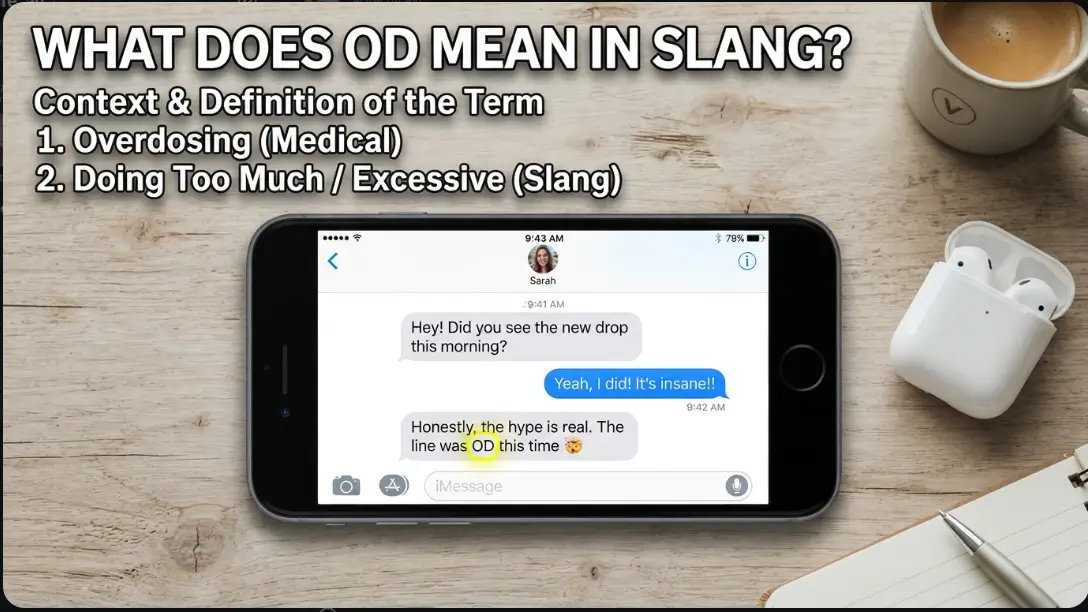
OD in slang means “extremely,” “a lot,” or “overly dramatic,” used to describe something taken to an extreme level. It comes from New York hip-hop culture in the 1990s and is unrelated to “overdose” in this context. Today it shows up in texting, TikTok, and everyday conversation as an intensifier, like “that test was OD hard.”
Key Takeaways
- OD as slang means “extremely” or “very,” used to boost the intensity of a statement.
- It started in New York hip-hop and street culture in the 1990s.
- The exact origin is unclear, but many trace it to the phrase “overly dramatic” or “over dose” used loosely.
- It’s still active today, especially in texting and on TikTok.
- The tone is casual and neutral it can describe good or bad things.
- It is different from “OD” meaning “overdose,” which is a medical term.
If you’ve seen someone text “that’s OD funny” or “I’m OD tired,” you’ve probably paused for a second. OD looks like it should mean overdose, but in slang, it means something totally different.
People search this term because it pops up constantly in texts, TikTok captions, and casual conversation, and the meaning isn’t obvious from context alone.This slang version of OD has been around for decades, mostly rooted in East Coast hip-hop culture.
It never really went away it just resurfaces in waves as new generations pick it up. You’ll spot it in comment sections, group chats, and short-form video captions where people want a quick way to say “a lot” or “way too much.”
This guide breaks down exactly what OD means in slang, where it came from, how people use it now, and how to avoid mixing it up with the medical meaning.
By the end, you’ll know when to use it, when to skip it, and what it says about the person using it.
What Does OD Mean in Slang?
OD in slang is an intensifier. It means “extremely,” “very,” or “way too much,” and it can attach to almost any adjective or situation.
The most common meaning is simple: OD boosts whatever comes after it. “OD tired” means very tired. “OD funny” means extremely funny. It works like the words “super,” “hella,” or “mad” in other regional slang.
There’s a second, related meaning tied to behavior. When people say someone is “being OD,” they usually mean that person is acting overly dramatic, extra, or excessive in a specific moment reacting harder than the situation calls for.
Both meanings share the same root idea: something pushed past a normal level.
Quick Meaning Box
| Meaning | Simple Explanation |
| Extremely / very | Used before an adjective to add intensity (OD hot, OD late) |
| Overly dramatic | Describes someone reacting bigger than needed |
| A lot / too much | Describes an amount or degree that feels excessive |
Pronunciation
OD is said as two separate letters: “oh-dee.” It’s not pronounced like a word just spell it out loud, the same way you’d say “TV” or “DJ.”
Where Does OD Come From?
OD in slang traces back to New York street and hip-hop culture in the 1990s. The exact origin is unclear, but it’s widely associated with East Coast slang from that era.
Many people connect the term to the phrase “overly dramatic,” shortened and flipped into an intensifier.Others link it loosely to “overdose,” stretched from its medical meaning into a casual way of saying “too much of something.
” Because slang spreads through speech long before it’s written down, pinning an exact first use is difficult, and no single confirmed source claims credit for coining it.
What’s clear is that hip-hop lyrics and New York street talk played a major role in spreading the term beyond its original neighborhoods. From there, it moved into wider youth culture through music, media, and everyday conversation.
History of the Term
In the 1990s, OD circulated mainly in New York City neighborhoods and hip-hop lyrics as slang for “extremely” or “excessively.
” It stayed fairly regional for years, most recognized by people connected to East Coast hip-hop culture.Over the 2000s and 2010s, the term traveled further as hip-hop’s influence grew nationally.
A low profile compared to more mainstream slang, but it never fully disappeared from casual speech, especially in Black and urban youth communities where it originated.
The rise of texting and social media gave OD a second life. Short, punchy slang like this fits perfectly into captions, comments, and quick messages.
It resurfaced strongly with Gen Z audiences, who picked it up as a fresh-feeling intensifier even though its roots go back decades.
How People Use It Today
OD shows up most in texting, TikTok captions, Instagram comments, and casual spoken conversation among younger users. It fits naturally into short, informal writing where a quick intensity boost matters more than formal grammar.
On TikTok and Instagram, people use it in captions to exaggerate a mood or reaction, like “OD proud of this one” under a video.
In texting, it works as a fast way to emphasize feelings “I’m OD hungry rn.” It’s less common in longer-form writing or on platforms built for more formal discussion.
What Does OD Mean in Slang Text?
In texts, OD works as a quick intensity booster dropped right before an adjective. It saves time compared to typing out “extremely” or “so incredibly,” which matters in fast-paced conversations.
A text like “this movie is OD boring” or “he’s OD late again” gets the point across instantly. Texting culture favors short, punchy words, and OD fits that need perfectly since it’s just two letters doing the work of a much longer phrase.
What Does OD Mean in Slang Urban Dictionary?
Urban Dictionary entries generally define OD as slang for “extremely,” “excessively,” or “over dramatic,” matching how it’s used in real conversation. Multiple entries on the site describe it as an intensifier tied to New York and hip-hop slang.
Crowdsourced sites like Urban Dictionary aren’t official dictionaries, so definitions can vary by contributor. Still, the entries for OD stay fairly consistent with each other, which lines up with how the term is actually used across texting and social media today.
What Does OD Mean in Slang, Not Overdose?
Outside of medical or drug-related contexts, OD almost always means “extremely” or “too much” rather than “overdose.” The slang meaning has nothing to do with drugs or medication.
Context makes the difference clear. “She OD’s on Xanax” refers to overdose. “She’s OD nice” refers to the slang intensifier.
Reading the surrounding words tells you instantly which meaning applies, since the two versions rarely get confused once you know both exist.
What Does OD Mean as a Slang Term?
As a slang term specifically, OD functions as an intensifier or adjective describing excess. It’s not a noun in this usage it modifies other words rather than standing alone as a thing.
This sets it apart from the medical abbreviation, which is a noun referring to a specific event (an overdose).
The slang version is grammatically flexible, working before adjectives (“OD hard”), verbs in some cases (“I OD miss this place”), or as a standalone reaction (“that’s so OD”).
What Does OD Mean in Slang in 2026?
In 2026, OD remains active slang for “extremely” or “very,” still common in texting and short-form video captions.
Its usage hasn’t shifted much from recent years it continues functioning as a casual intensifier among younger internet users.
Slang terms tied to intensity tend to have long shelf lives because they’re simple and endlessly reusable. OD fits that pattern, staying steady rather than fading out or dramatically changing meaning.
What Does OD Mean in Slang in 2025?
Through 2025, OD kept its place as a common intensifier in texting and social captions, largely unchanged from earlier usage. It didn’t gain a new definition or lose its older one it simply continued as part of everyday informal language for many users.
Its consistency is part of why it’s stuck around. Unlike trend-driven slang that burns out fast, OD’s simple function as an intensity booster keeps it useful across different years and platforms.
What Does OD Mean in New York Slang?
In New York slang, OD is a foundational intensifier rooted in the city’s hip-hop and street culture. It’s one of the clearest examples of NYC-originated slang that spread into broader youth language nationwide.
New York slang has shaped a huge amount of modern internet and texting language, and OD is part of that lineage.
People from the city or familiar with its hip-hop history often use it as second nature, while others picked it up later through music and social media.
What Does OD Mean in Gen Z Slang?
For Gen Z, OD works as a go-to intensifier in texting and captions, even though the term itself started decades before most of them were born. They use it the same way older generations did to mean “extremely” or “very.”
Gen Z often revives older slang through social media, and OD is a good example. It feels current because it’s actively used in trending content, even though its roots trace back to 1990s hip-hop culture rather than anything newly invented.
What Does OD Mean in American Slang?
Broadly across American slang, OD means “extremely” or “excessively,” most associated with hip-hop and East Coast origins but understood more widely today. It has moved beyond regional boundaries into general youth slang across the country.
While it started in a specific place and culture, its simple function as an intensifier made it easy to adopt anywhere. People who’ve never been to New York still use OD in texts without necessarily knowing its origin.
Examples in Everyday Conversation
- “Bro, that roller coaster was OD scary.”
- “I’m OD proud of you for finishing the race.”
- “This coffee is OD strong, my hands are shaking.”
- “She got OD mad over something so small.”
- “The line at that restaurant was OD long today.”
- “He’s OD smart, he finished the puzzle in five minutes.”
- “This apartment is OD small for the price.”
- “That was OD sweet of you to remember my birthday.”
- “The traffic on the highway was OD bad this morning.”
- “You’re being OD dramatic about losing one game.”
Text Message Examples
- “omg the exam was OD hard 😩”
- “this if is OD cold rn”
- “she’s OD funny when she tells stories”
- “I’m OD tired, going to bed early”
- “that concert was OD lit”
- “he’s OD late, like always”
- “this pizza place is OD good”
- “I’m OD nervous for tomorrow”
- “the movie ending was OD sad”
- “ur being OD extra rn lol”
Social Media Caption Examples
- Instagram: “OD grateful for this crew 🙏”
- TikTok: “when the food takes OD long to arrive”
- X: “this timeline is OD chaotic today”
- Threads: “OD proud of how this turned out”
- Facebook: “OD blessed to spend the day with family”
- Instagram: “this view is OD unreal 😍”
- TikTok: “POV: you’re OD late for work again”
- X: “not me being OD emotional over a commercial”
- Threads: “this playlist is OD underrated”
- Facebook: “OD thankful for everyone who showed up today”
Is It Positive or Negative?
OD itself is neutral it just adds intensity, and the tone depends entirely on the word it’s paired with. “OD sweet” is positive, while “OD annoying” is negative.
It can turn slightly rude when it’s used to call someone “OD dramatic” or “OD extra” in a mocking way, especially face-to-face.
Between friends, it usually reads as playful. Used to describe a stranger’s behavior in a public post, it can come across as more critical or judgmental, so context and relationship matter.
Who Uses This Slang?
OD is most common among teens and young adults, particularly those active on TikTok, Instagram, and in group texts.
It also stays in steady use among people connected to hip-hop culture and East Coast, especially New York, communities where it originated.
Older millennials and Gen X speakers familiar with 1990s hip-hop may recognize and use it too, since it’s not exclusively a Gen Z term.Gamers and online communities that borrow heavily from internet slang also use it casually in chat and voice conversations.
Similar Slang Words
| Slang | Meaning |
| Hella | Extremely, a lot (West Coast origin) |
| Mad | Very, extremely (also East Coast slang) |
| Extra | Overly dramatic or excessive |
| Deadass | Seriously, for real |
| Lowkey | Somewhat, secretly |
Opposite Words
- Chill calm, low intensity, the opposite of an OD reaction.
- Mild describes something low-key rather than extreme.
- Barely suggests a small amount instead of excess.
- Slightly a small degree, contrasting OD’s “a lot” meaning.
Common Mistakes
People sometimes assume OD only means “overdose,” missing the slang meaning entirely, which causes confusion in casual conversation.
Others use it incorrectly as a standalone noun (“that was such an OD”) when it usually functions as an intensifier before another word.
Spelling it as “oh-dee” or “ODD” in text is also a common error the correct casual spelling stays as “OD,” typically in caps.Some new users misuse it in formal contexts where it doesn’t fit at all, not realizing how casual the term reads.
When NOT to Use It
Avoid OD in professional emails, school assignments, résumés, or any formal writing, since it reads as slang and can seem unprofessional or confusing to readers unfamiliar with it. In workplace messages, it risks looking careless even if the sender means well.
It’s also worth skipping in mixed-audience settings, like a company-wide announcement or a message to someone significantly older or unfamiliar with slang, where the abbreviation for “overdose” might be assumed instead, creating an awkward or alarming misread.
Fun Facts
- OD as slang predates most of the internet slang people associate it with today.
- It functions grammatically as an intensifier, similar to “very” or “super.”
- The term is strongly tied to New York hip-hop culture from the 1990s.
- It has two distinct informal meanings: “extremely” and “overly dramatic.”
- Its short, two-letter format makes it especially popular in texting.
- Despite decades of use, its exact first recorded use remains unclear.
Frequently Asked Questions
1:What does OD mean when texting?
In texting, OD means “extremely” or “very,” placed right before an adjective to boost its intensity. It’s a quick way to emphasize a feeling or situation without typing a longer word.
For example, “I’m OD stressed about finals” simply means very stressed. It’s casual and common in fast, informal conversations between friends, especially in group chats where speed and tone matter more than formal grammar.
2:What does OD stand for on TikTok?
On TikTok, OD isn’t really an acronym standing for specific words it’s used the same way as in texting, meaning “extremely” or “way too much.” You’ll see it in captions like “OD embarrassing” or “OD relatable.
It fits TikTok’s fast, casual caption style, where short slang carries a lot of tone in very few characters, matching the platform’s quick, reaction-based content style.
3:What does OD mean in street slang?
In street slang, particularly from New York, OD means “extremely” or describes someone acting overly dramatic.
This is the term’s original context, rooted in 1990s hip-hop and neighborhood speech before it spread to wider youth culture. In this setting, it often carries a slightly harder or more direct tone than its lighter, meme-friendly social media use, though the core meaning stays the same.
4:What does an OD mean?
Without context, “an OD” most often refers to a medical overdose, since that’s the noun form of the abbreviation.
The slang version rarely appears as a standalone noun it’s almost always used as an intensifier before another word, like “OD funny.” If someone says “an OD” by itself, they’re most likely referring to the medical meaning, not the slang one.
Final Thoughts
OD is one of those slang terms that looks confusing at first but makes total sense once you know the context.It’s not about overdose at all it’s a simple, punchy way to say “extremely” or “way too much,” born out of New York hip-hop culture decades ago and still going strong in texts and captions today.
Knowing both meanings helps you read conversations correctly, if you’re scrolling TikTok or catching an old-school hip-hop reference.Use it with friends, in texts, or on social media, and save the formal language for emails and schoolwork.
Once you’ve got the hang of it, spotting the difference between “OD” the slang and “OD” the medical term becomes second nature.

Daniel Reed creates informative content focused on vocabulary, trending expressions, and language comparisons. His practical writing helps readers discover new insights on slangwordz.com