80s slang refers to the casual words and phrases that became popular in the United States during the 1980s many tied to surfer and skater culture, MTV, teen movies, and mall hangouts. Words like “radical,” “gnarly,” and “totally” expressed excitement or approval.
Some terms faded, while others still show up in conversation and memes today.If you’ve ever watched an 80s movie or heard your parents say something like “that’s so rad,” you’ve run into 80s slang.
This is the casual language that teenagers and young adults used throughout the decade to talk to friends, describe their favorite things, or make fun of something that seemed uncool. People search for 80s slang for a few reasons.
Some are writing a script or a party invite with an 80s theme. Others heard an older relative use a word and wanted to know what it actually meant.
And plenty of people just love nostalgia and want to relive the decade through its language.You’ll spot 80s slang in old sitcoms, teen comedies, music videos, and now in throwback TikToks and Instagram reels.
A lot of these words never really left. People still say “chill out” or call something “awesome” without thinking twice about where it came from.
This guide breaks down what 80s slang actually means, where it started, how it changed over time, and how people use it now. By the end, you’ll be able to spot it, use it correctly, and know exactly when to leave it out of a conversation.
What Does 80s Slang Mean?
80s slang isn’t one single word. It’s a whole category of casual expressions that were common during the 1980s. These words usually did one of a few jobs:
- Showed excitement or approval (“radical,” “awesome,” “tubular”)
- Described something as uncool or disappointing (“bogus,” “bummer”)
- Told someone to relax (“chill out,” “take a chill pill”)
- Called out a person’s style or attitude (“dweeb,” “poser,” “material girl”)
The meaning often depended on tone and context. Saying “that’s rad” about a new bike meant you liked it. Saying “way harsh” about a breakup meant it stung. A lot of these terms came from California surf and skate culture before spreading nationwide through movies, music, and television.
Example: “That new arcade game is totally rad.” → The game is impressive or exciting. “Ugh, my curfew got moved up. Bogus.” → That’s unfair or disappointing.
Quick Meaning Box
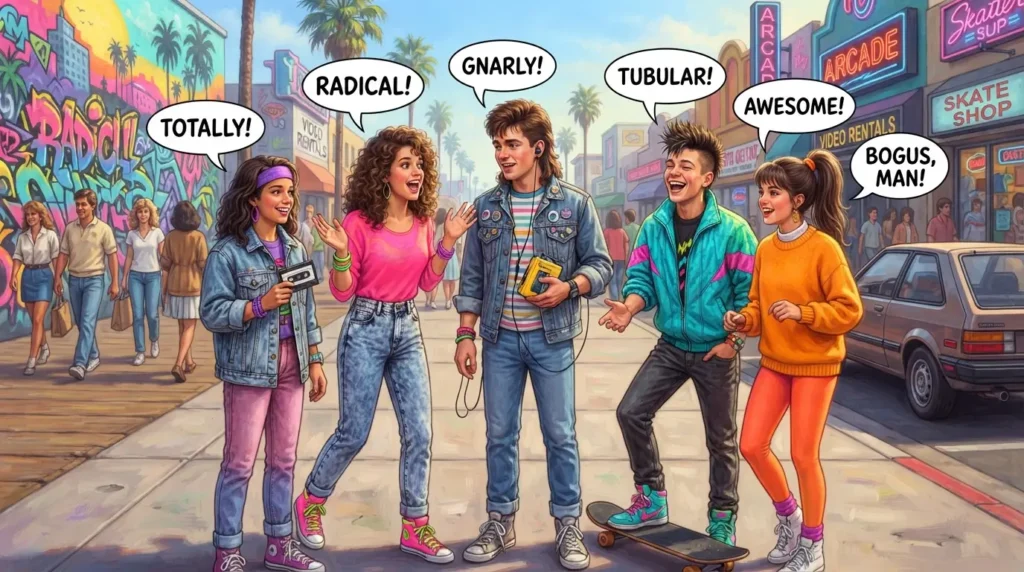
| Meaning | Simple Explanation |
| Radical / Rad | Cool, awesome, impressive |
| Gnarly | Intense, extreme, or impressively cool (can go either way) |
| Bogus | Fake, unfair, or lame |
| Bummer | A disappointing situation |
| Chill out | Relax, calm down |
| Totally | Absolutely, for emphasis |
| Tubular | Excellent, awesome (surf origin) |
| Dweeb | An awkward or uncool person |
Pronunciation
“80s slang” is pronounced EY tees slang. There’s no tricky phonetic twist here it’s said just like it reads. Individual slang words from the decade each have their own pronunciation, which is covered in the history section below.
Where Does 80s Slang Come From?
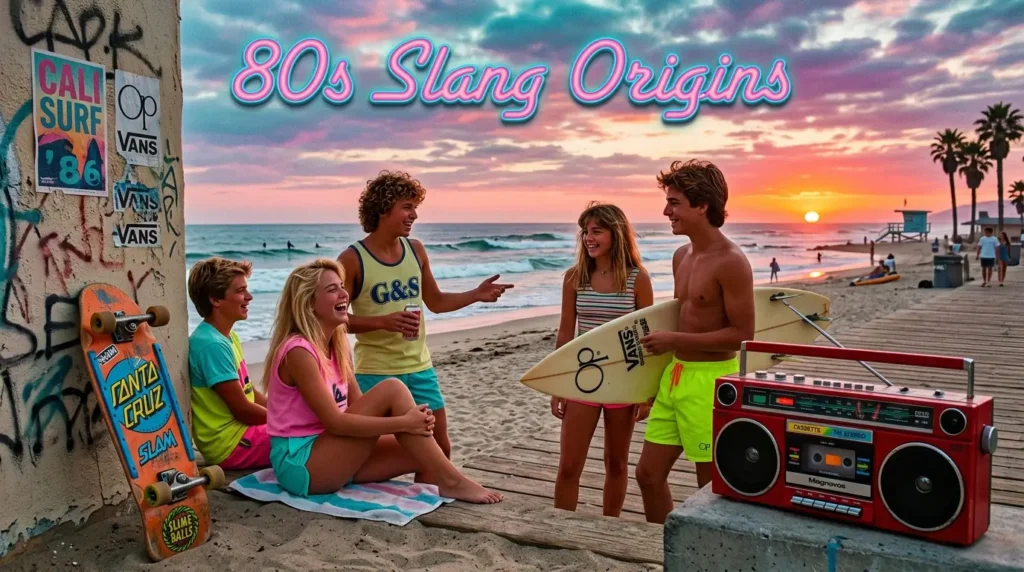
Most 80s slang has roots in California surf and skateboard culture from the late 1970s and early 1980s. Words like “gnarly” and “tubular” originally described wave conditions or skate tricks before teenagers started using them to describe anything impressive.
From there, movies and television spread the words across the country. Films like Fast Times at Ridgemont High and Valley Girl introduced audiences outside California to this style of speaking.
MTV, which launched in 1981, also played a big role by putting youth culture and music videos in front of a national audience every day.
The exact origin of some individual terms is unclear, and slang historians often disagree on precisely when a word first appeared versus when it became widely popular.
What’s clear is that 1980s teen culture, especially in Southern California, shaped a big chunk of the slang still recognized today.
History of the Term
Early in the decade, surf and skate slang stayed mostly regional, used by teens in California beach towns. As skateboarding and surfing culture grew more visible through magazines and early cable TV, the vocabulary started spreading.By the mid 1980s, teen movies turned this slang into a nationwide trend.
Audiences everywhere picked up words like “radical” and “awesome” from characters on screen. Music also played a part new wave and pop artists sometimes used slang in lyrics, which helped cement certain phrases in pop culture memory.
Toward the late 1980s and into the 1990s, some of these words faded out of everyday use, replaced by new decades’ worth of slang.
But a portion of it stuck around permanently. Words like “awesome,” “chill,” and “totally” are still common today, even though most people no longer think of them as “80s slang” they just think of them as normal words.
In recent years, 80s slang has seen a nostalgic comeback. Shows set in the decade, along with retro themed content on social media, have introduced these expressions to younger audiences who never lived through the era.
How People Use It Today
TikTok: Retro and nostalgia content often uses 80s slang for comedic effect, especially in videos comparing “then vs. now” trends.
Instagram: Captions on throwback photos sometimes borrow 80s phrases to match the aesthetic of the picture.
Reddit: Communities focused on retro pop culture or specific decades sometimes discuss and debate the meaning of older slang terms.
Text messages: Words like “chill” and “totally” are still used casually in everyday texting, even though they no longer feel tied to a specific decade.
Gaming: Retro styled or 80s themed games sometimes use period slang in dialogue to set the tone.
Not every platform leans on this slang the same way. Much of its modern use today is intentional and nostalgic rather than a natural, everyday habit like it was in the 1980s.
Examples in Everyday Conversation
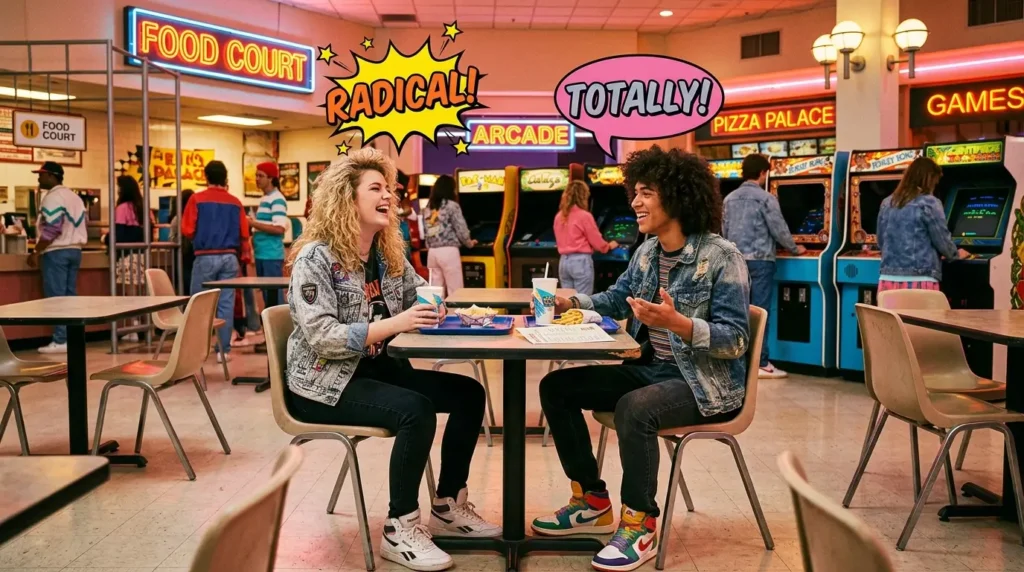
1. Friend 1: Did you see the new skate park downtown? Friend 2: Yeah, it’s totally tubular.
2. Friend 1: I failed my math test. Friend 2: Bummer, dude.
3. Friend 1: Can we go to the mall after school? Friend 2: For sure, that sounds rad.
4. Friend 1: My mom grounded me for the weekend. Friend 2: That’s so bogus.
5. Friend 1: Check out my new jacket. Friend 2: Whoa, that’s gnarly.
6. Friend 1: You’re freaking out over nothing. Friend 2: Chill out, it’s fine.
7. Friend 1: He wore the same outfit as the movie villain. Friend 2: What a dweeb.
8. Friend 1: We’re going to the concert tonight. Friend 2: Awesome, I’m so excited.
9. Friend 1: She copied my whole style. Friend 2: What a poser.
10. Friend 1: This homework is impossible. Friend 2: Way harsh, man.
Text Message Examples
- “party at jakes house 2nite, its gonna b rad “
- “ugh my curfew got moved up, so bogus”
- “chill out, ill be there in 5”
- “that new song is totally awesome”
- “just saw the movie, so gnarly”
- “cant come out tonight, bummer”
- “hes such a dweeb lol”
- “for sure ill be there”
- “she thinks shes so cool, what a poser”
- “way harsh that they cancelled the trip”
Social Media Caption Examples
Instagram: “Throwback to the most radical summer ever 🕶️”
TikTok: “POV: it’s 1985 and everything is totally awesome”
Twitter/X: “Just re watched an 80s classic and now I only speak in slang, it’s gnarly out here”
Threads: “Bring back saying ‘bogus’ instead of ‘that’s not fair,’ it just hits different”
Facebook: “Found my old mixtape and now I’m feeling nostalgic for the whole rad decade”
Is It Positive or Negative?
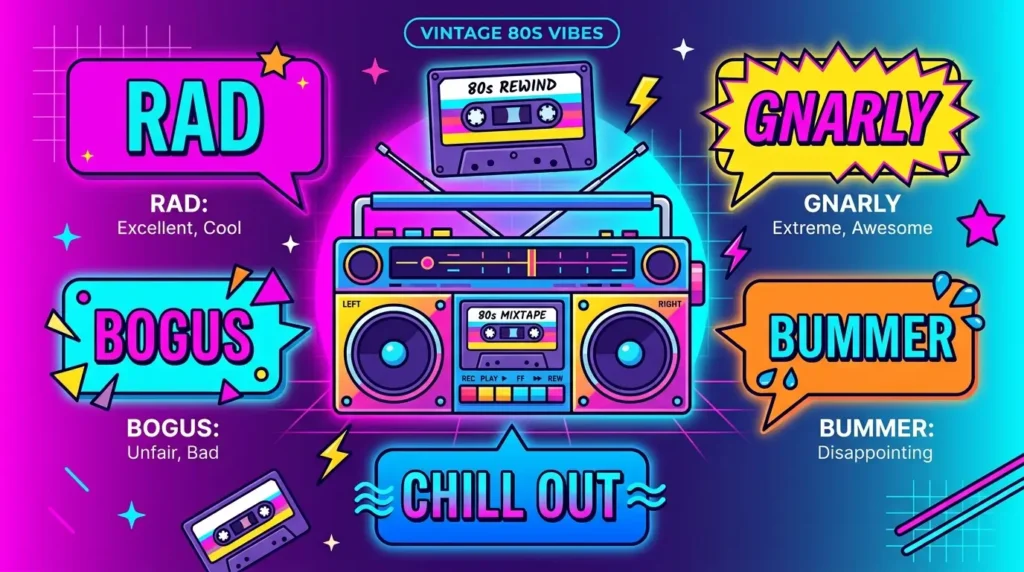
Most 80s slang leans positive. Words like “radical,” “rad,” “tubular,” and “awesome” express excitement or approval. But a few words carry a negative tone, like “bogus” and “bummer,” which describe something unfair or disappointing.
“Gnarly” is trickier because it can go either way. It might describe something impressively extreme, like a wave or a stunt, or it could describe something rough or unpleasant, depending on the tone of voice.
Misunderstandings can happen when someone uses a word ironically or sarcastically without the listener catching the tone. Reading it in a text message without context can also make the meaning less obvious than hearing it spoken aloud.
Who Uses This Slang?
Teenagers in the 1980s were the original users, especially those connected to surf, skate, and mall culture. Adults today who grew up in that decade still use some of these words casually, often without thinking of them as slang at all.Gamers and internet users sometimes bring back 80s slang for retro or ironic effect, especially in content styled after the decade.
Regionally, Southern California had the strongest early connection to this vocabulary because of its surf and skate roots, though the words spread nationwide once movies and TV picked them up.
Pop culture keeps this slang alive. Decade themed parties, retro aesthetics, and nostalgic movies or shows continue to introduce these words to people who never experienced the 1980s firsthand.
Similar Slang Words
| Slang | Meaning |
| Rad | Short for radical, meaning cool or awesome |
| Awesome | Impressive or excellent |
| Chill | Relaxed or calm |
| Fresh | Stylish or new (also tied to hip hop culture) |
| Groovy | An older term (1960s 70s) meaning cool or pleasant |
Each of these words shares the same basic job as core 80s slang: expressing approval or describing something positively.
Opposite Words
- Whack Describes something bad or poorly done.
- Bogus Already covered above, but functions as an opposite to “rad” or “awesome.”
- Basic A more modern term for something unoriginal or boring.
Common Mistakes
A common mistake is assuming every 80s slang word means the same thing across every context. “Gnarly,” for example, changes meaning depending on tone.
Another mistake is misspelling words, like writing “toataly” instead of “totally,” or mixing up “tubular” with “tubular” being used outside of its surf related origin without knowing the connection.
People sometimes also try to use this slang in serious or formal situations, which can come across as awkward or out of place rather than fun or nostalgic.
When NOT to Use It
Professional emails: Casual slang like “totally rad” doesn’t fit the tone of business communication and can seem unprofessional.
School assignments: Formal writing, like essays or reports, calls for standard language rather than slang, unless the assignment specifically asks about slang as a topic.
Business meetings: Using outdated or overly casual slang in a meeting can distract from the message you’re trying to communicate.
Formal writing: Slang generally doesn’t belong in resumes, cover letters, or official documents, since it can undercut a professional tone.
Fun Facts
- MTV launched in 1981, which helped speed up how quickly youth slang spread across the country.
- Several classic 80s teen movies, including Fast Times at Ridgemont High, helped popularize surf and skate slang nationwide.
- Many 80s slang words originally came from surf and skateboard culture before crossing over into mainstream teen speech.
- Some words from the decade, like “awesome” and “chill,” are still used today without most people realizing their slang origins.
- The exact origin of many individual slang terms is unclear, since slang typically spreads through spoken conversation before it’s ever written down.
80s Slang That People Still Use Today
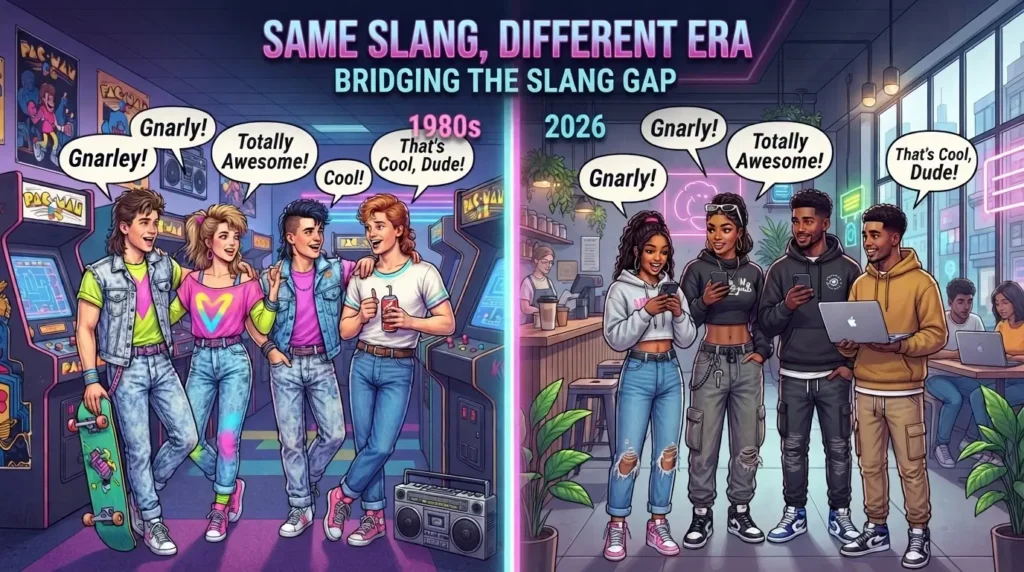
Although many expressions disappeared after the 1980s, several slang words are still common today. Words like awesome, cool, totally, gnarly, and dude continue to appear in conversations, movies, television shows, and social media. Some words have kept their original meaning, while others are now used in slightly different ways. Learning these terms helps readers understand both classic pop culture and modern informal English.
| Slang | Still Used Today? | Meaning |
|---|---|---|
| Awesome | Yes | Very good |
| Dude | Yes | Person or friend |
| Cool | Yes | Excellent |
| Totally | Yes | Completely |
| Gnarly | Sometimes | Amazing or difficult |
Frequently Asked Questions
1:Is 80s slang offensive?
No, most 80s slang isn’t offensive. Words like “radical,” “awesome,” and “chill out” were simply casual ways to express excitement or tell someone to relax.
A few terms, like “dweeb” or “poser,” could come across as mildly insulting depending on tone, but they weren’t meant to target anyone based on identity. As with any slang, context and delivery matter more than the words themselves.
2:Who created 80s slang?
There’s no single creator. Most of it developed naturally within California surf and skate communities during the late 1970s and early 1980s.
Teenagers coined and reshaped these words casually, and movies, music, and television later spread them nationally. The exact origin of specific words is often unclear since slang usually spreads through everyday conversation.
3:Is 80s slang still popular?
Some words stuck around and are still common today, like “awesome” and “chill.” Others, like “tubular” or “gnarly,” are now mostly used for nostalgic or comedic effect rather than everyday conversation. It has seen a bit of a comeback thanks to retro themed content on social media.
4:Can adults use 80s slang?
Absolutely. Many adults who grew up in the 1980s still use this slang naturally without thinking of it as retro. Adults revisiting the decade through nostalgia or theme parties also use it comfortably, since it’s tied to a shared cultural memory rather than a specific age group today.
5:Is it Gen Z slang?
No, 80s slang predates Gen Z by decades. However, some Gen Z users have picked up certain 80s words through nostalgic trends, retro movies, or memes, often using them ironically or as a throwback reference rather than as their everyday vocabulary.
6:Is it old slang?
Yes, by definition, 80s slang originated in the 1980s, making it several decades old. Some words have aged into standard vocabulary, while others are now considered outdated or tied specifically to that era.
7:How do you pronounce 80s slang words?
Most 80s slang words are pronounced exactly as they’re spelled, with no unusual phonetic twists. For example, “gnarly” is pronounced NAR lee, and “tubular” is pronounced TOO byuh ler.
8:What are similar words to 80s slang?
Words like “rad,” “awesome,” “chill,” and “fresh” share similar positive meanings. Some, like “groovy,” come from an earlier decade but serve a similar purpose of expressing approval.
9:Can I use 80s slang at work?
It depends on the workplace culture. Casual workplaces or informal chats between coworkers might tolerate it in a joking way, but formal emails, meetings, and official communication should avoid it to maintain a professional tone.
10:Why is 80s slang trending again?
Nostalgia plays a big role. Retro themed shows, movies, and social media trends have brought renewed attention to 1980s culture, including its slang. Younger audiences discovering this era through pop culture often pick up the vocabulary as part of the aesthetic.
Final Thoughts
80s slang gives a fun window into how teenagers talked, dressed, and hung out during one of pop culture’s most memorable decades
A lot of it grew out of surf and skate culture in California before spreading through movies, music, and MTV to the rest of the country.Some of these words faded with time, while others became so common that people forget they were ever considered slang at all.
If you’re throwing a retro party, writing a script, or just curious about something you heard in an old movie, understanding this slang gives you a clearer picture of 1980s culture.
Next time you hear someone call something “totally rad” or tell a friend to “chill out,” you’ll know exactly where that phrase came from and why it’s stuck around so long.

Daniel Reed creates informative content focused on vocabulary, trending expressions, and language comparisons. His practical writing helps readers discover new insights on slangwordz.com